
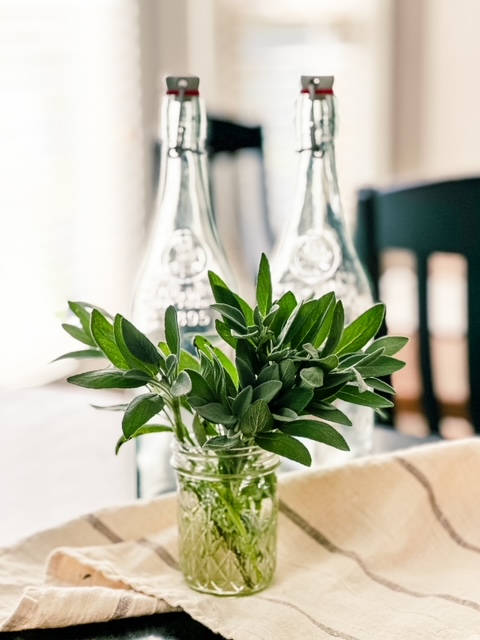
By late summer my sage plants seem to forget all restraint. What begins as a modest culinary herb in spring soon becomes a sprawling mound of soft gray-green leaves, fragrant every time I brush past it on my way through the garden. Before long I’m gathering armfuls, far more than I could ever use fresh in the kitchen.
One of my favorite ways to preserve that abundance is by making a simple sage-infused oil. This is not an essential oil distilled for aromatherapy, but a gentle culinary infusion that captures the warm, earthy character of fresh sage. Throughout autumn and winter, a spoonful stirred into roasted vegetables, brushed over chicken, or drizzled into soups adds the unmistakable flavor of the herb garden long after the growing season has ended.
Poured into a pretty glass bottle, it also makes a thoughtful hostess gift or a welcome addition to a holiday gift basket.
A FEW NOTES BEFORE YOU BEGIN
*Harvest sage in the morning after the dew has evaporated but before the heat of the day begins to draw away its aromatic oils.
*Rinse the leaves well, then dry them completely in a single layer on paper towels, in a dehydrator, or in a very low oven. The leaves should be thoroughly dry before infusing the oil.
*Warm the oil only enough to encourage the sage to release its natural oils. A temperature of about 105°F (40°C) is ideal. If the oil becomes too hot, it will begin cooking the leaves rather than gently extracting their flavor.
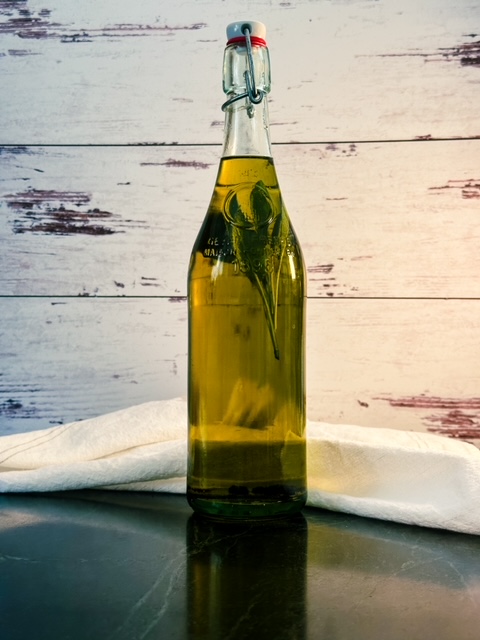
*After the infusion is complete, strain out all of the sage leaves. If you would like the bottle to be easily identifiable, add one or two decorative dried sage leaves after straining rather than leaving the original leaves in the oil to continue infusing.
Sage pairs especially well with carrots, onions, lemon, potatoes, winter squash, mushrooms, and roasted chicken. For best food safety, store the finished oil in the refrigerator and use it within about one month. Always discard it if it develops an off odor or signs of spoilage.
SAGE OIL RECIPE
Ingredients
2 cups extra virgin olive oil or avocado oil
2 cups lightly packed, thoroughly dried sage leaves
30 whole black peppercorns, divided
Equipment
1 large glass mason jar with a tight-fitting lid
Fine-mesh strainer
Decorative bottle or glass decanter
Directions
1. Place the dried sage leaves in a clean mason jar.
2. Lightly crush 20 of the peppercorns and add them to the jar.
3. Gently warm the oil to approximately 105°F.
4. Pour the warm oil over the sage, ensuring the leaves are completely submerged.
5. Allow the oil to cool completely before sealing the jar.
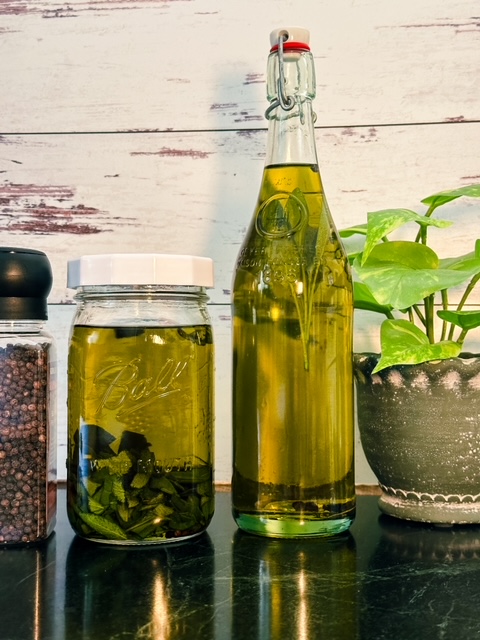
6. Store the jar in a cool, dark place for two to three weeks, gently shaking it several times each week.
7. Begin tasting after two weeks. When the flavor is to your liking, strain the oil through a fine-mesh sieve into its final bottle.
8. Add the remaining 10 whole peppercorns to the finished bottle for a simple decorative touch.
A bottle of sage oil is one of those quiet pleasures that reminds me why I garden in the first place. It captures the fragrance of a July morning and carries it forward into the cool evenings of October, the Thanksgiving table, and the slow meals of winter. There is something deeply satisfying about preserving not only the harvest, but the memory of the season itself.