

What Theo of Golden Reveals About Seeing, Listening, and Preserving Ordinary Lives
One of my favorite summer pastimes is curating a stack of books for our annual beach trip. There is such luxury in those unhurried days spent reading and thinking beneath the generous shade of an umbrella—the ocean folding its emerald waves against the shore, the wind tousling my hair, and a cooler of cold drinks within easy reach.
My list of possibilities was longer than usual this year: The Summer Book by Tove Jansson, The Country Heart by H. E. Bates, The Outermost House by Henry Beston, and several others. But one title kept resurfacing: Allen Levi’s Theo of Golden.
Almost everyone I knew had already read it, and the reviews were glowing. Ordinarily, that would not have persuaded me. I have learned that what “everybody” is reading does not always suit my particular tastes, and I was reluctant to surrender any of my already-too-short beach time to a novel that might prove overly sentimental.
So I reached a compromise with myself: I would read it before the vacation.
I am very glad I did.
Every so often, a book gives language to something we have long felt but have not yet known how to say. Theo of Golden did that for me.
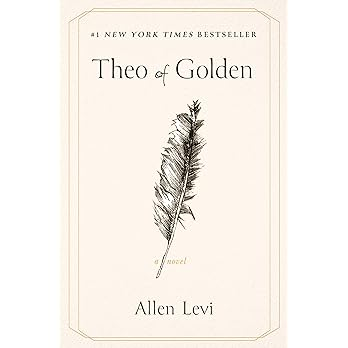
At the center of the novel is Theo, an enigmatic 86-year-old Portuguese man who arrives in the fictional Southern town of Golden shortly before Easter. At a local coffeehouse called The Chalice, he discovers 92 pencil portraits of townspeople, all drawn by a local artist.
Theo purchases the portraits and begins locating the people whose faces they bear—not to keep the drawings for himself, but to return them to their “rightful owners.”
Each presentation becomes an occasion for conversation. Theo listens as people share their histories, sorrows, regrets, and hopes. Through his patient attention, he often helps them recognize the meaning in lives they may have considered unremarkable. Although he enters Golden as a stranger, his attentiveness quietly begins to change the community. The mystery of who he is—and why he has come—unfolds gradually.
Yet the portraits are only the beginning.
Theo’s real gift is his attention. He sits with people. He asks about their lives. He listens without rushing. He receives each person’s story as something worthy of being heard.
As I read, I recognized something at the heart of Land & Lore: the conviction that every person carries a story, every place holds memory, and much of what is worth preserving may be lost unless someone first takes the time to notice.
The portraits are more than likenesses. Each one seems to say:
You were here. You were seen. Your life belongs to this place.
Perhaps this is why Theo’s story feels especially timely. The hurried pace of modern life, compounded by the distractions of the digital world, has left many of us feeling disconnected—not only from ourselves, but also from the people nearest to us.
Consider the hidden histories all around us: the widow sitting quietly in the church pew, the man repairing a roof, the gardener sharing tomatoes across a fence, the longtime shopkeeper, the neighbor whose family has lived along the same road for generations.
What joys and sorrows have shaped them? What do they remember that no one has thought to ask? What have they learned through decades of tending families, homes, congregations, businesses, gardens, and pieces of land?
Have we stopped seeing one another? Have we forgotten how to listen? Have we lost the habit of sharing our stories across tables, porches, counters, garden fences, and generations?
Perhaps our failure to notice one another is one small part of the loneliness that has settled over so much of modern life. We may be surrounded by people and yet remain largely unknown to one another.
Theo offers another way.
His greatest gift is not his money or even the portraits. It is his willingness to give another person his undivided presence. He listens without treating the conversation as an interruption. He approaches each life with curiosity and reverence, as though something of great value might be entrusted to him if only he is patient enough to receive it.
Theo does not make people important by noticing them. He notices the importance that was already there.
This is the work I hope Land & Lore will undertake—not merely telling impressive stories, but looking closely enough to recognize the significance of ordinary ones.
To notice the people who have quietly tended families, gardens, businesses, churches, neighborhoods, and pieces of land.
To listen before their memories disappear.
To preserve something of who they were, what they loved, and what they knew.
Theo reminds us that attention is not a passive thing. It is a form of generosity. Sometimes it is even a form of love.
We may never arrive in a town carrying his means or his mystery. But we can enter our own communities with the same spirit of attentiveness—and with the same quiet question:
Who here has been waiting to be seen?