“Part of the soul food culinary tableau, tea cakes likely derive from the English tradition of consuming a biscuit or cookie with tea. Carried to the New World by European settlers, the tradition spread among enslaved people, who used small amounts of cast-off ingredients to create humble versions of the original.” ~Lily Williams, Founder and President of the Southern Food and Beverage Museum in New Orleans
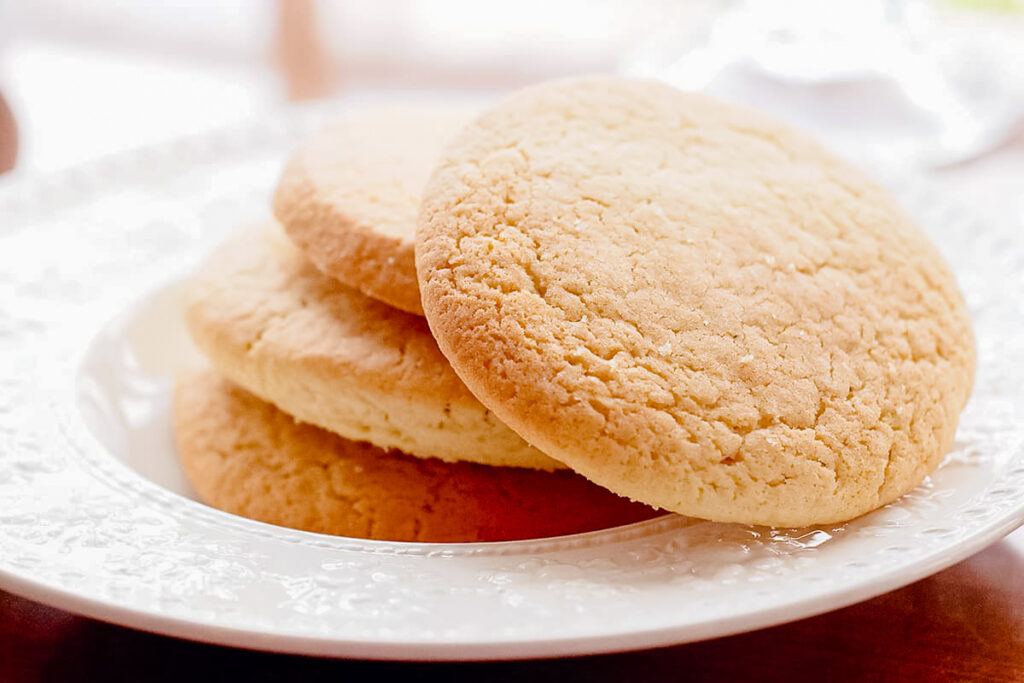
Less sweet than a sugar cookie, the old fashioned tea cake is not quite a cookie but not exactly a cake either. Its soft cakey texture inside is utterly delicious and became a classic comfort food and a special baked treat during the holidays, which is where I first encountered it.
My grandmother baked these simple cakes every Christmas for as long as I could remember and I always looked forward to eating them. By the time the tradition reached my grandmother’s kitchen, the tea cake had become more than an old recipe. It had become part of our family’s Christmas story.
When I grew older and became interested in the history of the culinary arts, I realized that these soft little cakes had a rich history that ties us to the generations of people who baked them before us.
Speaking about its storied history, one descendant of slaves put it into perspective this way: “The tea cake was a way to savor life and have something sweet even when things were hard.”
Food has always carried more than nourishment. Recipes preserve memory long after photographs fade and voices grow quiet. Every generation receives a handful of ordinary things–a favorite hymn, a cast-iron skillet, a garden seed, a handwritten recipe–and quietly decides whether they are worth passing on.
The old-fashioned tea cake reminds me that culture is rarely preserved by institutions alone. More often it survives because someone still measures the flour, creams the butter, and places warm cakes on a Christmas table for children who have no idea they are participating in history.
Cookie Consent
By using Land & Lore, you consent to cookies that improve your experience on the site.
Cookie Preferences
Manage your cookie preferences below:
Essential cookies enable basic functions and are necessary for the proper function of the website.
Name
Description
Duration
Cookie Preferences
This cookie is used to store the user's cookie consent preferences.
30 days
These cookies are needed for adding comments on this website.
Name
Description
Duration
comment_author
Used to track the user across multiple sessions.
Session
comment_author_email
Used to track the user across multiple sessions.
Session
comment_author_url
Used to track the user across multiple sessions.
Session
Statistics cookies collect information anonymously. This information helps us understand how visitors use our website.
Google Analytics is a powerful tool that tracks and analyzes website traffic for informed marketing decisions.
Contains information related to marketing campaigns of the user. These are shared with Google AdWords / Google Ads when the Google Ads and Google Analytics accounts are linked together.
90 days
__utma
ID used to identify users and sessions
2 years after last activity
__utmt
Used to monitor number of Google Analytics server requests
10 minutes
__utmb
Used to distinguish new sessions and visits. This cookie is set when the GA.js javascript library is loaded and there is no existing __utmb cookie. The cookie is updated every time data is sent to the Google Analytics server.
30 minutes after last activity
__utmc
Used only with old Urchin versions of Google Analytics and not with GA.js. Was used to distinguish between new sessions and visits at the end of a session.
End of session (browser)
__utmz
Contains information about the traffic source or campaign that directed user to the website. The cookie is set when the GA.js javascript is loaded and updated when data is sent to the Google Anaytics server
6 months after last activity
__utmv
Contains custom information set by the web developer via the _setCustomVar method in Google Analytics. This cookie is updated every time new data is sent to the Google Analytics server.
2 years after last activity
__utmx
Used to determine whether a user is included in an A / B or Multivariate test.
18 months
_ga
ID used to identify users
2 years
_gali
Used by Google Analytics to determine which links on a page are being clicked
30 seconds
_ga_
ID used to identify users
2 years
_gid
ID used to identify users for 24 hours after last activity
24 hours
_gat
Used to monitor number of Google Analytics server requests when using Google Tag Manager