
The Very Hungry Caterpillar, Again
For more than fifty years, children—and the adults who love them—have delighted in the little caterpillar who eats his way through an astonishing feast before quietly transforming into a magnificent butterfly.
There is something timeless about Eric Carle’s stories. Their bold colors, simple language, and gentle rhythms invite children into a world where wonder lives in ordinary things: a caterpillar, a firefly, a spider, a brown bear. Through everyday moments, children learn to observe, to imagine, and to notice the natural world around them.
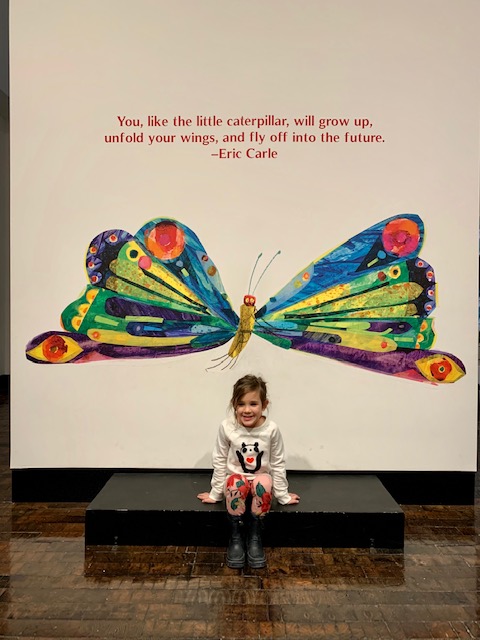
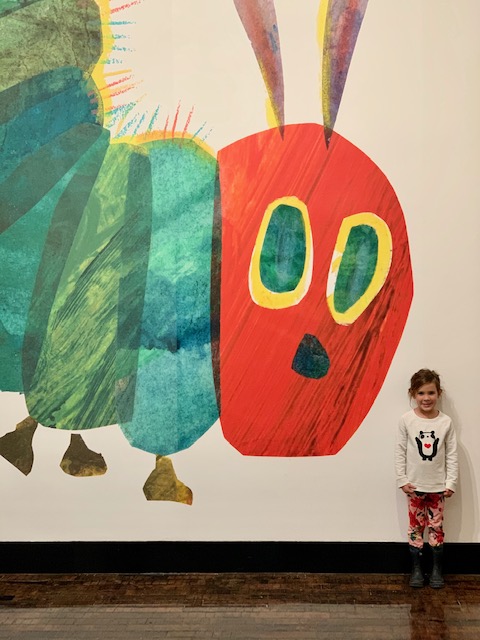
The Frist Art Museum’s Eric Carle exhibition captures that sense of wonder beautifully. Cozy floor pillows rest on soft green “grass” rugs, colorful reading nooks invite families to linger over favorite books, and Carle’s original collage illustrations line the gallery walls.
Who doesn’t smile at the sight of the Blue Horse, the Purple Cat, or the Lonely Firefly?
Carle, born in Syracuse, New York, in 1929, found inspiration throughout his life in the simple experiences of childhood and in the beauty of nature. Using hand-painted papers assembled into vibrant collages, he created stories that have introduced generations of children to butterflies, bears, crickets, spiders, peacocks, beetles, and countless other creatures. His books remind us that growth, change, curiosity, and discovery are part of every life.
This weekend, Shiloh and I wandered through the exhibition together.
She seemed most fascinated that I already knew every one of the characters. When I told her I had read these very same books to her daddy when he was a little boy, she looked at me with quiet amazement, as though I had somehow stepped into one of the stories myself.
As we sat together reading The Very Hungry Caterpillar, she enthusiastically chimed in on every familiar refrain. Once again I was reminded how naturally children learn through repetition—how stories, rhythms, and patterns quietly shape young hearts and minds.
But what surprised me most was the wave of nostalgia that washed over me.
Years ago, I had turned these pages with my own son curled beside me. Now his daughter sat in that very place, finishing the sentences before I could read them aloud.
The books had not changed.
The stories had not changed.
What had changed was the generation listening.
In that quiet museum gallery, surrounded by bright colors and whimsical creatures, I found myself reflecting on one of life’s sweetest gifts: stories that outlive us. They become bridges between generations, carrying imagination, affection, and memory from one small pair of hands to another.
Perhaps that is the true magic of a great children’s book. It doesn’t simply entertain a child. It becomes part of a family’s shared history, waiting patiently until the next little voice is ready to say, “But he was still hungry.”