

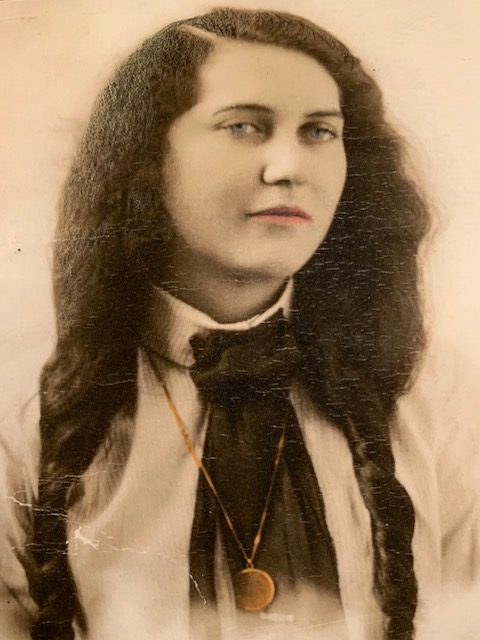
I stared in astonishment at the photograph my elderly aunt had recently placed in my hands.
The young woman looking back at me could not have been more than eighteen. Her gaze was steady, her posture confident, her expression quietly self-assured. Even more startling was the unmistakable resemblance I saw in some of her features to my own.
The photograph, taken in 1912, bore all the marks of a century’s passage. Its edges were worn, its tones softened with age, but the young woman remained vividly present.
She was my paternal grandmother, Rosalie Heaton.
I had never seen this photograph before.
At the time it was taken, Rosalie was attending the Alabama Girls Technical Institute—later renamed the University of Montevallo. Curious to know more, I began reading the school’s history. Founded in 1896, the institution represented an ambitious and unusual vision for its day: to provide young women with an education that would enable them to become self-supporting and intellectually equipped in a state where educational opportunities for women were still remarkably limited.
The university described its mission this way:
“At last, a school in Alabama whose purpose was to educate women to be self-supporting… an opportunity for young women to expand their minds and dreams.”
I paused over those words.
Until that moment, I had never imagined my grandmother as a pioneer.
One forgotten photograph, tucked away in a family collection for decades, quietly overturned the picture I had carried of her all my life.
Years after that photograph was taken, Rosalie would marry my grandfather, Earnest Clifton Cross, move to a farm near Georgiana, Alabama, raise seven children, endure the hardships of the Great Depression, watch her three sons leave to serve during World War II, and become a widow at just forty-six years of age. The determination I glimpsed in that young woman’s face suddenly made sense. Long before life demanded extraordinary courage of her, it had already begun shaping it within her.
Yet the Rosalie I had always known existed in a much later chapter.
She was the sixty-five-year-old grandmother who, in 1959, opened the door of her small house on Mandrell Street when my father arrived carrying an infant and leading a frightened three-year-old little girl—both of us suddenly without a mother.
She simply said yes.
She welcomed us into her home without knowing how long we would stay or what sacrifices that decision would require. Looking back now, I have always regarded that moment as one of God’s quiet mercies—His gracious provision for two grieving children whose future had suddenly become uncertain.
For many years, that single act defined my understanding of who my grandmother was.
Now another story has joined it.
A century-old photograph revealed not only the grandmother who rescued two little girls, but also the courageous young woman she had once been. It reminded me that every life is far larger than the chapter we happen to know. Before every elderly face was a young dreamer. Before every seasoned soul was someone stepping into an uncertain future with hope, ambition, and courage.
Perhaps that is one of the gifts of old photographs.
They invite us to see people whole.
Perspective rarely arrives with fanfare. More often it comes quietly, through an old photograph, a forgotten letter, a family story finally told. Nothing in the past changes, yet everything looks different because we have learned to see more clearly.
And perhaps that is true beyond our family histories.
Every person we meet is living a story whose earlier chapters we have never read. When we remember that, we become slower to judge, quicker to honor, and more willing to extend grace.
Sometimes all it takes is a single photograph to remind us that every life contains more courage, more sorrow, and more beauty than first meets the eye.