

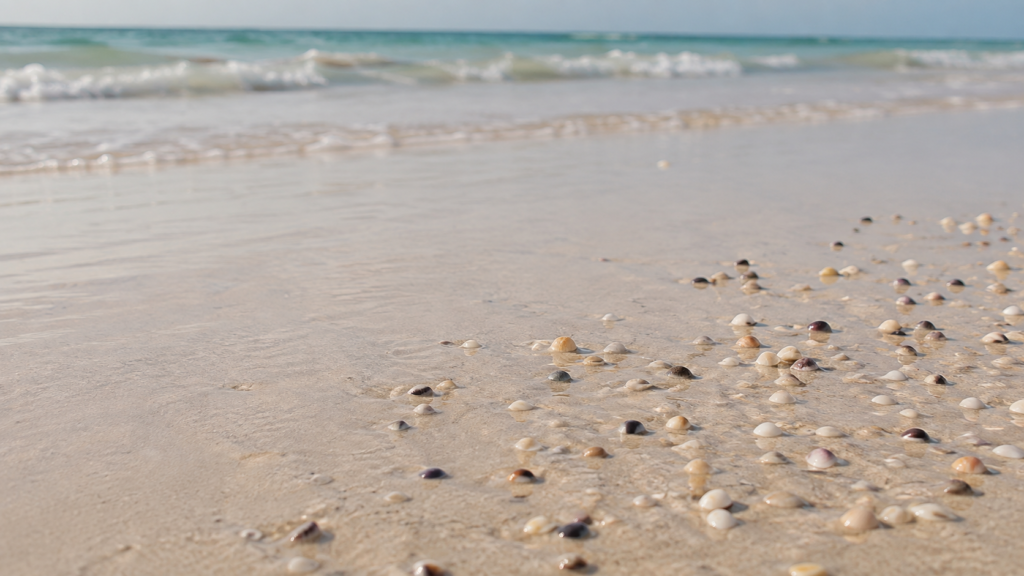
The breaking waves roll in from the Gulf, their white crests falling with the soothing repetition of a lullaby. A salt-laden breeze softens the sun’s warmth, making even the late-summer heat feel comfortable.
This morning, the Emerald Coast has settled into the lazy luxury of its late-season rhythm. The beach is nearly empty. The long sweep of shoreline seems to belong only to the gulls, the waves, and the few of us fortunate enough to be walking there.
I am thoroughly enveloped in the peacefulness of it all, grateful for the week ahead.
Moving at an unhurried pace along the water’s edge, I feel my feet sink into the wet sand. Warm waves tumble over them and wash away my footprints behind me, leaving no evidence that I have passed this way.
Most of the waves come and go without distinction. But after a while, I begin to notice that every so often one breaks differently, scattering dozens of tiny objects across the wet sand.
At first, I think they are small seashells deposited by the surf. But when I bend to pick one up, something remarkable happens.
In the few seconds it takes the wave to recede, the little shells right themselves and begin digging into the sand. Almost as quickly as they appeared, they vanish.
These shells are alive.
I am witnessing one of the beach’s smallest and most delightful dramas.
They are coquina clams—tiny, wedge-shaped mollusks with smooth, glossy shells resembling the enamel of a human tooth. Their appearance varies wonderfully. Some are ivory or cream; others are gray, lavender, pink, brown, or nearly black. Many are marked with delicate stripes and bands, as though each had been individually painted.
A breaking wave can uncover an entire colony and tumble the clams onto the surface. As the water recedes, they orient themselves and use a small, muscular foot to burrow back into the wet sand. Within seconds, dozens disappear from view.
What I had mistaken for empty shells was a living community responding to the rhythm of the surf.
The coquinas inhabit the swash zone—the narrow strip of beach continually covered and uncovered by waves. They were not being washed ashore from some distant place. They had been living beneath the very sand where I was walking.
One thought remained with me.
When the coquinas were exposed, they immediately sought cover. Their response was instinctive and entirely natural: self-preservation.
They were not ashamed. They were not frightened in the human sense. They were simply doing what they were made to do. When the sea exposed them, they buried themselves again.
Human beings do something remarkably similar, although our hiding is far more complicated.
The coquina has sand. We have accomplishments, appearances, busyness, carefully chosen words, beautiful houses, clothing, humor, competence—even silence.
We cover our weaknesses. We conceal grief. We carefully manage what other people are allowed to know about us.
We hide failure, family troubles, loneliness, uncertainty, aging, disappointment, and sometimes even our deepest hopes. When an unexpected wave exposes us—a loss, an illness, criticism, failure, confession, or embarrassing moment—our instinct may be much like that of the little creatures along the shoreline:
Find cover. Quickly. Do not remain exposed.
But is all hiding wrong?
Sometimes covering ourselves is wisdom. Privacy is not dishonesty. Retreat can be restorative. A wounded creature seeks shelter, and human beings need safe places too.
Perhaps the deeper distinction is not between concealment and exposure, but between shelter and hiding.
Shelter gives us a safe place from which we may eventually emerge.
Hiding asks that we never be seen.
Perhaps the problem is not that we seek covering. Perhaps the question is what we choose to cover ourselves with.
For the coquina, the sand is exactly where it belongs. Its covering allows it to live.
What are the coverings that allow us to live well?
Home. Family. Friendship. Community. Faith. Place. Familiar rituals. Work worth doing. People before whom we do not have to perform.
And what are the false coverings—the things beneath which we disappear rather than become whole?
The wave itself is not the enemy.
The same Gulf that exposes the coquina also sustains it. The waves uncover it, carry its food, and move it along the shoreline. Exposure and shelter are both part of its life.
Human life may be something like that.
The circumstances that expose us are not always those from which we need to be rescued. Sometimes being uncovered reveals something we need to see. It shows us which coverings have sheltered us and which have merely kept us hidden.
Another wave arrives, and the sand is swept clean.
To anyone passing by, the shoreline appears empty again. But now I know that beneath my feet are dozens—perhaps hundreds—of brilliantly colored little lives that were invisible to me only moments before.
Perhaps that is the final revelation.
How much life lies hidden beneath the surface of the ordinary world?
And how much remains hidden beneath the surface of the people we pass every day?