

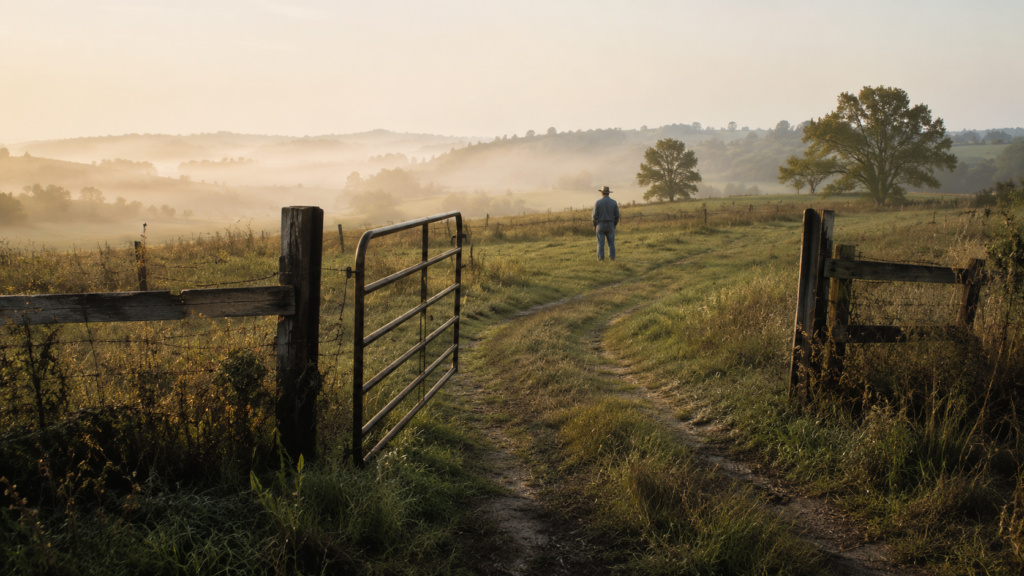
On the death of Wendell Berry and the inheritance of attention
Wendell Berry died on August 31, 2026, at his home in Port Royal, Kentucky. He was ninety-two years old.
The news came quietly, as news of death often does: a few words on a screen announcing that a life has ended. Yet some deaths require us to stop. Not because we knew the person, or because we believe ourselves entitled to a private grief, but because the life that has ended helped us understand our own.
I did not know Wendell Berry. I never sat at his table, walked the hills of his farm, or heard him read beneath the trees. He did not know my name. Still, his work has accompanied me. It has given language to convictions I carried before I knew how to name them, and it has helped me recognize the work I am meant to do.
Berry spent a lifetime insisting that places matter. Not places in the abstract, but particular places: a field whose soil has been tended or depleted; a town remembered by those who stayed; a river bearing both beauty and injury; a kitchen table around which the living and the dead somehow continue to gather. He wrote of land, marriage, neighbors, work, loss, and membership. Again and again, he returned to the truth that we belong to one another and to the places entrusted to our care.
That word—entrusted—matters.
To see the world as entrusted to us is different from seeing it as raw material for our ambition. What is entrusted may be used, but it must not be used carelessly. It must be known, tended, and handed on. The land is not merely acreage. A town is not merely a market. A family is not merely a collection of individuals. A story is not merely content. Each has a life and an integrity beyond what it can produce for us.
This understanding lies near the heart of Land & Lore. Every place has a story worth preserving—not because every story is grand, but because attention is one of the ways we honor what God has made and what human lives have borne within it. A weathered house, an inherited recipe, a garden planted again, a family photograph with names written on the back: such things become small witnesses against forgetting.
Berry taught many of us to recognize those witnesses.
He did so not only through argument but through the shape of his life. After years away, he returned to Henry County, Kentucky, where generations of his family had lived and farmed. There, with his wife, Tanya, he made a home, worked the land, raised a family, and wrote. He remained for more than sixty years.
There is a moral weight in that staying.
Berry did not make a sentimental idol of rural life. He knew its failures, cruelties, losses, and compromises. He understood that belonging to a place means accepting responsibility for what has happened there as well as delighting in what is beautiful. To love a place truthfully is to refuse both contempt and illusion. It is to see clearly and remain answerable.
His authority came, in part, from the coherence between what he wrote and how he chose to live. He warned against the industrial destruction of land while farming his own acres. He defended local communities while submitting himself to the claims of one. He wrote about fidelity while practicing the long disciplines of marriage, home, neighborliness, and return. His life was not flawless; no faithful life is. But it was integrated. His convictions were not kept safely on the page.
That integrity is increasingly rare. We live in a culture that rewards reach more readily than rootedness, speed more readily than patience, and visibility more readily than faithfulness. We are encouraged to move on, scale up, replace, and reinvent. The damaged thing is discarded. The forgotten place is passed by. The ordinary life is judged too small to matter unless it can be turned into spectacle.
Berry offered another measure.
He reminded us that a life may become consequential by becoming particular. That the world may be served by loving one portion of it well. That good work is often repetitive and uncelebrated. That limits are not always enemies of freedom but may be the boundaries within which love becomes concrete. That we cannot care for everything everywhere, but we can learn the names, needs, histories, and seasons of what has been placed near us.
These were not merely agrarian ideas. Beneath them was a Christian understanding of creatureliness: that the world is created, not manufactured by us; that our lives are dependent, not self-sufficient; and that dominion without humility becomes destruction. Berry’s work continually returned us to gratitude, restraint, neighbor love, and the holiness of the given world. He would not allow faith to remain detached from soil, food, money, labor, or the treatment of other people. Belief had to take bodily form in the way one lived.
For those of us who came after him, admiration is not enough.
It would be easy to honor Berry by collecting his loveliest sentences, placing his books on a prominent shelf, or mourning the disappearance of a world we imagine he represented. But nostalgia without obedience asks nothing of us. Berry’s work asks something.
It asks whether we will pay attention before another place is altered beyond recognition.
It asks whether we will learn the stories of the people nearest us while they are still here to tell them.
It asks whether our work will heal the memberships on which life depends or further divide them.
It asks whether we will receive creation as a gift, exercise stewardship with humility, and resist the assumption that whatever can be exploited should be.
And it asks whether we are willing to stay—with a place, a people, a calling, or a difficult truth—long enough to know and love it faithfully.
I have thought of Wendell Berry as a mentor, though only from a distance and through the written word. A true mentor does not give us a life to imitate in every detail. He helps us see the shape of faithfulness within our own life. Berry’s Kentucky farm is not mine to inherit. Port William is not mine to recreate. But the discipline of attention, the obligation of memory, and the call to love a particular place are inheritances that can be received anywhere.
For me, that receiving takes form in Land & Lore. It means looking again at the places I might otherwise pass without seeing. It means preserving stories before time loosens their names from the world. It means believing that beauty and truth still reside in ordinary lives, cultivated ground, old photographs, family tables, and the accumulated wisdom of people who have learned to belong somewhere. It means making work that does not merely attract attention, but gives attention.
Berry’s death does not create this calling. But it clarifies it.
A great voice has gone quiet in the Kentucky hills. The books remain, as do the land he tended, the people who loved him, and the communities his work has strengthened. Yet a living witness cannot be replaced by his collected words. When an elder dies, something passes from presence into inheritance. What he carried so visibly must now be borne, in many smaller and distinct ways, by those who remain.
We need not become Wendell Berry. We could not.
But we can refuse to live as though place does not matter. We can resist the casual erasure of memory. We can honor limits, tend what has been entrusted to us, and practice fidelity where we are. We can tell the truth about the places we love without ceasing to love them. We can do work that serves rather than consumes. We can receive the ordinary world with gratitude and hand it on with care.
This is not the work of admirers alone.
It is the work the living must carry.